Beyond the Checkbox: Building a Kinky Getaway That Actually Fits Your Body
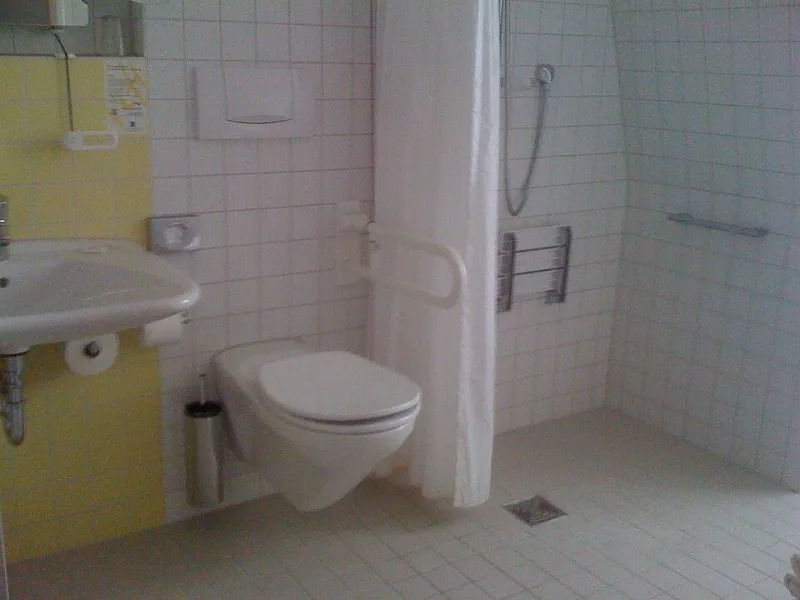
Photo: Martin Kliehm from Frankfurt am Main, Germany, CC BY-SA 2.0, via Wikimedia Commons
The listing said "accessible." The photos showed a ramp and a wide bathroom. What the photos did not show was a bed so low it made transfers a project, a bedroom rug that grabbed a wheelchair wheel, and a play space where the only available surface was a glass coffee table.
Accessible travel marketing is built on checkboxes. Actual accessibility is built on specifics, and specifics are the one thing you have to go get yourself. That's not fair, and it's not a small amount of labor — but it is doable, and a little advocacy up front buys you a trip where you're not spending your energy on logistics instead of pleasure.
What an Accessibility Checkbox Actually Covers
In the United States, the ADA gives you real, enforceable baseline protections at hotels — accessible routes, modified bathrooms with grab bars, accessible parking, and rooms designed to certain dimensions. That's a floor, not a ceiling. It says nothing about bed height, floor surface, whether the hallway fits your chair with a partner walking beside you, or whether there's anywhere in the room you can comfortably be on your knees.
So ask for measurements. Real ones. Doorway clear width, threshold height, bed height, whether the shower has a curb, elevator interior dimensions, and how many steps sit between the parking spot and the bedroom door. Ask for a video walkthrough instead of a photo set — one slow phone video shot from the front door will tell you more than twenty staged images.
And read the reviews, especially the ones from other disabled travelers. Google photo reviews and disability-specific travel forums regularly catch what the marketing department missed.
Private Rentals: More Control, More Homework
Whole-home rentals are often the better call for lifestyle travelers with access needs, for a simple reason: you can move the furniture. You can control light, temperature, and sound. You can bring your own equipment and set it up the way your body actually works. You can also arrange early check-in for setup and late checkout for recovery, which matters more than people realize.
But "step-free" in a rental listing is self-reported and sometimes generous. Ask the host to walk the route from the car to the bedroom on video and narrate it. Ask about the floor surface in each room — hardwood, low-pile carpet, and thick rugs each change what's possible. Ask how wide the halls are, not just the doorways.
If you're bringing mobility equipment, be honest about the vehicle. A folding chair and a power chair are different logistical problems, and a gravel driveway is a different driveway than the photo suggested.
Mapping the Play Space Before You're In It
This is the part nobody writes about, and it's the part that matters most. Before the scene, walk the room and answer three questions: where can I sit, where can I kneel, and where can I lie down? If a position isn't in one of those three answers, it's not in the scene tonight.
A short list that earns its luggage space: a wedge pillow, a firm mat, knee pads, a stool with a back, and a cushion that survives hardwood. A chair with arms is dramatically easier to get out of than one without. Keep water, your phone, medication, and your brake signal within arm's reach from every position you plan to use — not across the room because that's where the outlet was.
If suspension is part of your plan, verify the anchor, the ceiling height, the manufacturer's load rating, and whether the property or venue permits it at all. Never assume a hardpoint is rated for people, and never rig to plumbing, ceiling fans, or a beam that hasn't been checked.
And budget your energy the way you'd budget money. Floor-based play is not a lesser scene — it's often a smarter one. Plan the arc around what your body has available tonight, not around a video you watched.
Sensory Access Is Access
Accessibility isn't only mobility. Retreats and play parties are sensory environments, and they can be brutal if light, sound, smell, and crowd density aren't on your radar.
Lighting matters: ask whether the space is dimmable, and bring your own — battery candles and a couple of small lamps beat overheads with a flicker. Sound matters; hard floors and high ceilings turn a party into a reverb chamber, so pack earplugs and scope out a quiet room before you need one. Temperature matters at floor level, where it's always colder than you expect. Scent matters if you're sensitive to cleaning products or air fresheners, so ask the host to skip them and bring unscented everything.
And check textures. Rope material, sheet fabric, and latex sensitivities are real considerations that are much easier to plan for than to troubleshoot mid-scene.
Medication, Timing, and the Flare-Day Plan
Pack double your usual supply in your carry-on, keep prescriptions in their original labeled packaging, and photograph everything. If you need refrigeration, confirm the fridge actually works on arrival rather than trusting the listing. Set alarms across time zones for scheduled doses, and declare ice packs and sharps at security instead of hoping they slide through.
Then build a bad-day plan. What does this trip look like if you flare? Keep one low-effort version of the vacation available — a version that still counts. That single decision removes a huge amount of anxiety from the front end.
Also, before you go: know the nearest 24-hour pharmacy and the nearest emergency room. Write it down. Because the worst time to look it up is the time you need it.
Talking to Hosts and Organizers
You don't owe anyone a diagnosis. You owe them logistics, and logistics are easier to give than a medical history.
Try written, specific questions: "I use a mobility aid. Can you confirm the path from parking to the bedroom is step-free and at least 36 inches wide?" Then screenshot the answer. If a host gets weird, evasive, or offended, that's not a red flag you need to interpret — it's an answer. Book elsewhere.
For retreat organizers, ask directly: Is there accessible play furniture? A quiet room? Have you hosted disabled guests before? Is the accessible bathroom being used as gear storage? That last one happens constantly, and it's worth asking before you arrive.
If you're traveling with a service animal, US businesses have clear obligations under the ADA, but short-term rentals operate under murkier rules — ask early and get it in writing.
The Bottom Line
A trip that accommodates your body isn't a compromised version of a good time. It's the version where you actually get to be present for it. Ask the annoying questions, demand the measurements, and don't let a marketing checkbox decide what your vacation looks like.