Gear Up and Go: The Discreet Traveler's Playbook for Getting Your Scene Kit Through Security
Let's be real: packing for a lifestyle vacation is not the same as throwing a swimsuit and some sunscreen into a carry-on. You've got gear. Maybe a lot of it. And while there's absolutely nothing illegal about traveling with most scene equipment, that doesn't mean you want to have a long, awkward conversation with a TSA agent about your rope collection in front of a crowded security line.
The good news? Getting your kit from point A to point B discreetly is completely manageable with a little forethought. Here's how to do it like a pro.
Know What You're Actually Working With Before You Pack
Before you start stuffing things into a bag, take stock of what you're bringing and think critically about each item. Ask yourself three things: Is it legal to travel with this domestically? Is it legal at my destination? And could it reasonably be mistaken for something it's not?
For most standard scene gear — rope, restraints, blindfolds, floggers, leather accessories — the answer to all three is pretty straightforward. These items are legal to own and transport in the US. TSA's job is to find threats to aircraft safety, not to police your personal lifestyle. A set of wrist cuffs is not going to trigger a federal investigation. That said, sharp implements like certain impact toys with metal components, medical-grade tools, or anything with an edge should be packed in checked luggage, full stop.
If you're traveling internationally, do your homework on your destination country's laws around adult items. Some countries have strict import regulations around anything that could be classified as a "sex toy" or restraint device. A quick search of your destination's customs rules — or a call to your travel agent if you're using one — can save you a serious headache at the border.
The Checked Bag Is Your Best Friend
For the bulk of your gear, checked luggage is simply the smarter play. It keeps your items out of the X-ray conveyor belt theater at the security checkpoint, and it gives you a lot more flexibility in terms of what you can pack without triggering questions.
A few tips for packing your checked bag well:
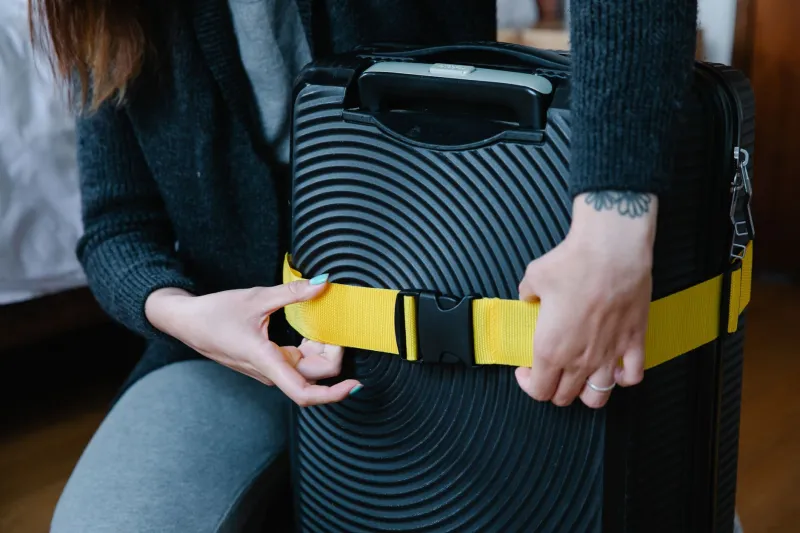
- Use a hard-sided suitcase with a TSA-approved lock. This keeps your bag secure during handling and means only a TSA agent — not a random baggage handler — can open it if it needs to be inspected.
- Pack scene items in the middle of the bag, surrounded by clothing. This isn't about hiding anything illegal; it's just smart packing that reduces the visual impact of your gear on an X-ray scan.
- Wrap metal items separately. Tangled metal in an X-ray image tends to attract attention. Keeping things organized and wrapped in clothing or soft pouches makes the scan cleaner.
- Don't overstuff. TSA agents are more likely to physically open and search a bag that looks crammed and chaotic on the screen. A well-organized bag reads as low-risk.
If your bag is opened and inspected, TSA will leave a notice inside. Nothing will be confiscated unless it's actually prohibited. Rope, leather, and restraints don't make that list.
Carry-On Strategy: Keep It Minimal and Mundane
If you're bringing anything in your carry-on — maybe a small kit for a first-night arrival when your checked bag feels like it takes forever — keep it simple and nondescript. Small items like a blindfold, a length of soft rope, or a collar can travel in a carry-on without issue, but pack them in a small pouch or toiletry bag so they're contained and not just floating around loose.
Avoid packing anything that could be mistaken for a weapon — even something like a heavy metal carabiner or certain paddle designs with a rigid handle can cause a second look. When in doubt, check it.
Also: label your bags. A luggage tag with your name and phone number means your bag finds its way back to you if it gets separated. You don't need to advertise what's inside, but you do need your contact info on the outside.
If You Get Pulled Aside: Stay Calm, Stay Vague
It happens occasionally — a bag gets flagged, an agent wants to take a second look, or you get selected for additional screening. This is not a crisis. Here's how to handle it:
Stay calm and cooperative. TSA agents are doing a job. Anxiety or defensiveness draws more attention than the gear itself ever would.
You don't owe anyone an explanation. If an agent pulls out an item and looks at you questioningly, a simple "those are personal items" is a complete sentence. You're not required to explain your hobbies, your vacation plans, or your lifestyle.
Know what's prohibited and what isn't. If an agent tells you something can't travel in your carry-on, ask if it can go in your checked bag instead. Most of the time, the answer is yes, and the airline can usually check your carry-on at the gate if needed.
The vast majority of lifestyle travelers never have a single issue. The scenario where a TSA agent makes a scene about your rope collection is genuinely rare — these folks are looking for explosives and weapons, not judging your weekend plans.
Customs and International Considerations
Flying internationally adds a layer of complexity. Customs declarations are about goods you're bringing into a country, and most personal-use items don't need to be declared unless they exceed certain value thresholds or fall into specific restricted categories.
For lifestyle gear, the key considerations are:
- Know your destination's laws. Some countries in Asia, the Middle East, and even parts of Europe have restrictions on adult items. Research before you pack.
- "Personal use" matters. Customs agents are generally less concerned about a few personal items than they are about large quantities that suggest commercial intent. Pack what you actually need for the trip.
- Electronics with motors — certain toys and devices — can sometimes be questioned at customs. Having them in your checked bag rather than your carry-on reduces scrutiny.
- Returning to the US, you're generally in the clear with personal items you took with you. If you bought anything new abroad, keep receipts and be aware of the duty-free exemption limits.
The Mindset That Makes It All Easier
Here's the thing that experienced lifestyle travelers know that first-timers sometimes miss: the discomfort is mostly in your head. You're not doing anything wrong. Your gear is legal. Your vacation is your business. The logistics of getting there are just logistics.
Pack smart, check the big stuff, keep your carry-on clean, and know that a calm, matter-of-fact attitude is your best travel accessory. By the time you land at your destination, the only thing on your mind should be the adventure waiting for you on the other side of baggage claim.
Now go pack that bag. The scene isn't going to set itself.